

The Income Summary account exists within the GL, alongside all other asset, liability, equity, revenue, and expense accounts. Permanent accounts, also known as real accounts, are bookkeeping for cleaning business not closed at the end of the accounting period. This meticulous procedure ensures the accuracy of subsequent financial statements. The Income Summary account holds a unique and vital position within the accounting cycle. It serves as a temporary holding account used exclusively during the closing process.
INCOME SUMMARY ACCOUNT: Definition and How to Close

The closing entries are the journal entry form of the Statement of Retained Earnings. The goal is to make the posted Accounting Periods and Methods balance of the retained earnings account match what we reported on the statement of retained earnings and start the next period with a zero balance for all temporary accounts. The income summary account receives the balance at year end from the revenue and expense accounts. Once that’s completed, the income summary account is closed as well by transferring its balance to a capital account.
Income summary journal entry
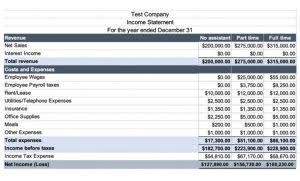
They are integral in determining the overall profitability and financial health of an organization. By analyzing expense transactions, businesses can gauge their operational efficiency, identify cost-saving opportunities, and make informed decisions to optimize expenditure. Through this series of journal entries, the financial statements accurately reflect the company’s performance and ensure a smooth transition into the next accounting period. Once all the adjusting entries are income summary account made the temporary accounts reflect the correct entries for revenue, expenses, and dividends for the accounting year. We can also see that the debit equals credit; hence, it adheres to the accounting principle of double-entry accounting. In this example we will close Paul’s Guitar Shop, Inc.’s temporary accounts using the income summary account method from his financial statements in the previous example.
How do you close revenue accounts?
Permanent accounts, also known as real accounts, do not require closing entries. Examples are cash, accounts receivable, accounts payable, and retained earnings. These accounts carry their ending balances into the next accounting period and are not reset to zero. We will use the 3-steps process to close the revenue and expense accounts before closing the income summary account. The general rule is that balance sheet accounts are permanent accounts and income statement accounts are temporary accounts. In practice, temporary accounts require a little more attention than permanent accounts.

- That makes it much easier for auditors to later confirm that amounts in the balance sheet and elsewhere are legitimate.
- Closing all temporary accounts to the retained earnings account is faster than using the income summary account method because it saves a step.
- After preparing the financial statements and adjusting the trial balance, the next step in the accounting cycle is to close the books for the year.
- From an accountant’s perspective, the Income Summary is akin to a checkpoint in a marathon; it’s where one assesses performance before moving forward.
- It aggregates all revenues and expenses recorded during the period and facilitates the transfer of net results (income or loss) to a permanent equity account.
- Use the chart below to determine which accounts are decreased by debits and which are decreased by credits.
On the other hand, if it is on the debit, it presents the net loss of the company. The General Ledger (GL) system serves as the central repository for all financial data, including information related to the Income Summary account. Effective data management within the GL is crucial for maintaining the integrity and accuracy of financial reporting. The Income Summary account serves as a temporary holding place for the net effect of revenues and expenses. Auditors, both internal and external, rely on the Income Summary account as a crucial element in their audit process.
This process involves transferring the credit balance of the income and expense accounts to the income summary account, with the debit and credit sides then compared to ascertain the net income or net loss. By utilizing the trial balance data, the income summary account helps in reconciling the financial records at the end of the accounting period. This final step ensures that all revenues and expenses have been accounted for accurately, leading to a comprehensive understanding of the company’s financial performance for the period. This systematic approach ensures that all temporary accounts are reset for the new accounting period, allowing for accurate financial reporting. The income summary account facilitates the transfer of net income or net loss to the retained earnings account, impacting the balance sheet of the organization.
Other Transfers
It’s where all the year’s revenues and expenses are compiled before their final distribution. For a business owner, this account reflects the culmination of a period’s financial efforts, showing clearly whether the company has operated at a profit or a loss. Therefore, the retained earnings account shows the earnings that are kept, net income fewer dividends in the business.
Credit Cloud
At the core of this suite is the Financial Close Management solution, which simplifies and accelerates financial close activities, ensuring compliance and reducing errors. Temporary accounts can either be closed directly to the retained earnings account or to an intermediate account called the income summary account. The income summary account is then closed to the retained earnings account. Temporary account balances can be shifted directly to the retained earnings account or an intermediate account known as the income summary account.

This entry takes the amount contained in the company’s revenue account off the books. Its significance is evident in providing a concise snapshot of the company’s financial status and preparing financial statements for stakeholders and regulatory compliance. Revenue transactions directly influence the income summary account, contributing to the organization’s overall profitability and affecting entries in the general ledger. LiveCube Task Automation is designed to automate repetitive tasks, improve efficiency, and facilitate real-time collaboration across teams.